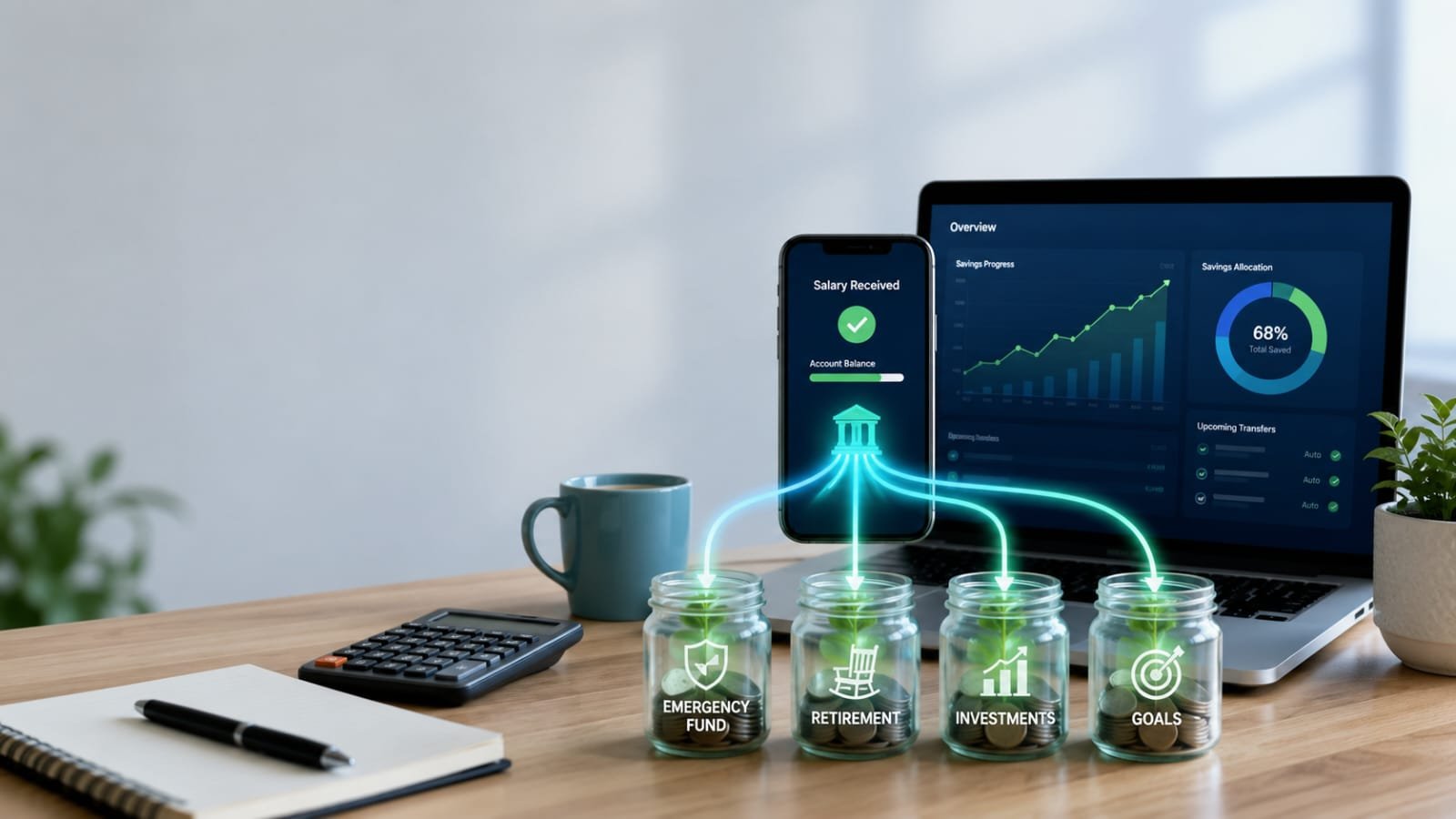
One of the most persistent myths in personal finance claims that saving money requires ironclad willpower. We are constantly told to track every dollar. Moreover, experts advise us to skip the daily latte. Finally, we are expected to move leftover cash into savings at month’s end.
However, relying on willpower is a losing strategy. By the end of the month, unexpected expenses rapidly drain your checking account. Similarly, emotional spending and subscription renewals eat away at your funds. As a result, you try to save whatever remains, but you usually find nothing left.
Therefore, to build sustainable wealth, you must flip this traditional model on its head and automate your savings. You can achieve this using a framework called “Paying Yourself First.” Consequently, the moment you build an automated system, you eliminate decision fatigue and guarantee steady financial progress.
What Does It Mean to Pay Yourself First?
Most people approach budgeting using a flawed formula:
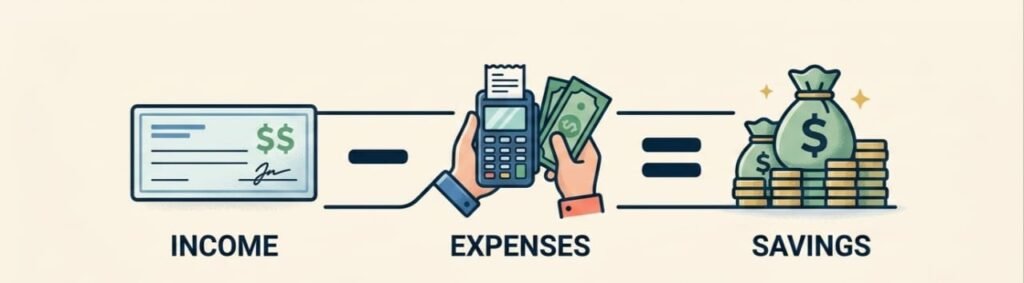
Under this traditional model, people treat savings as an afterthought. Thus, building wealth becomes their absolute lowest priority.
Conversely, paying yourself first flips the equation entirely:
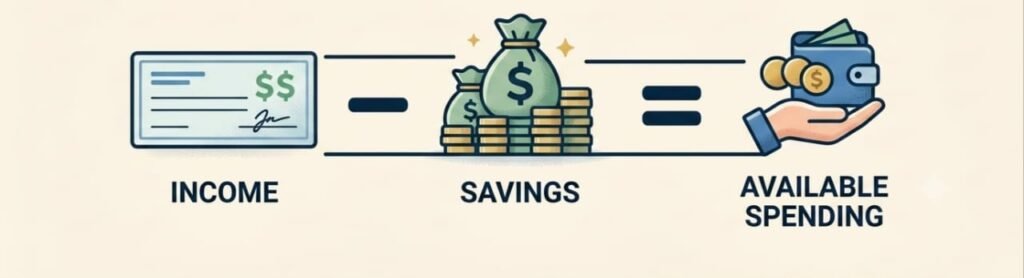
Instead of hoping for leftover money, you treat your future goals as non-negotiable expenses. Therefore, by automating transfers on payday, you protect your wealth from impulse spending before you can touch it.
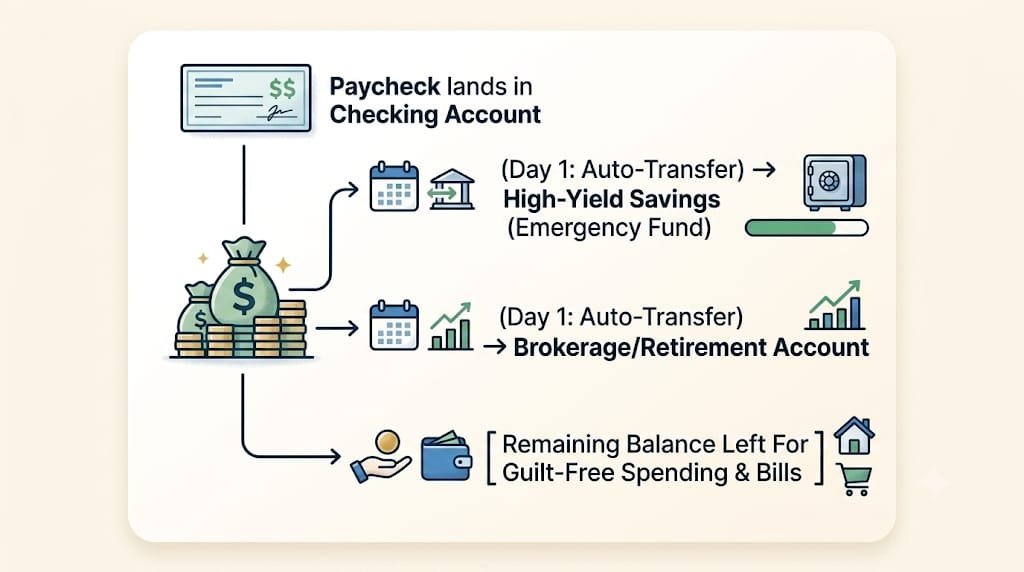
Under this framework, you treat your goals like your most important monthly bills. Consequently, you fund them before you pay the landlord, utility company, or grocery store. You create a system that locks away your wealth immediately. What remains in your checking account is then yours to spend completely guilt-free.
Step 1: Audit and Define Your Savings Buckets
Before you can build your automated engine, you need to map out exactly where your money needs to go. Instead of dumping all your savings into a single, generic account, split your goals into distinct, purpose-driven “buckets.”
- The Peace of Mind Bucket (Emergency Fund): Holding three to six months of living expenses for genuine emergencies.
- The Future Wealth Bucket (Investments): Long-term wealth generation via retirement accounts or low-cost index funds.
- The Target Milestone Bucket (Short-Term Goals): Savings earmarked for specific upcoming expenses, like a house down payment, travel, or a new vehicle.
Next, assign a specific percentage or fixed dollar amount to each bucket based on your current cash flow.
Step 2: Choose the Right Infrastructure
An automated savings engine requires strong financial tools. Therefore, to maximize returns and keep money organized, open a High-Yield Savings Account (HYSA) that features “sub-accounts” or “buckets.”
Traditional brick-and-mortar banks offer dismal interest rates, often hovering around 0.01%. In contrast, online-first HYSAs offer significantly higher yields. As a result, your money actively combats inflation while sitting securely. Furthermore, top-tier modern banks let you create digital sub-accounts under one primary login. Thus, you can easily track how much money goes to individual goals.
Step 3: Configure Your Payday Routing
Timing forms the core of the “Pay Yourself First” engine. Ultimately, the goal is to make money invisible before your brain registers it as available liquidity. You can configure your automated routing in two primary ways:
Method A: Direct Deposit Splitting (The Gold Standard)
The cleanest way to automate your savings is at the payroll level. Most employers allow you to split your direct deposit across multiple bank accounts.
- How to set it up: Access your company’s HR or payroll portal. Input the routing and account numbers for your primary checking account (for bills and lifestyle spending) and your HYSA.
- The Workflow: Direct 80% of your paycheck to checking and 20% straight to your savings buckets. The money never touches your daily spending account, rendering it completely invisible.
Method B: Automated Calendar Transfers
If your employer does not support multi-account direct deposits, or if you work as a freelancer with irregular income, you can replicate this engine using your bank’s automated transfer tools to create an automated savings system.
- How to set it up: Identify your consistent payday schedule (e.g., the 1st and 15th of the month). Log into your banking app and schedule recurring transfers from your checking account to your savings buckets to trigger one day after your paycheck arrives.
- The Buffer Rule: Always leave a 24-hour window between your expected deposit time and your automated outbound transfers to account for processing delays.
The Psychological Power of Guilt-Free Spending
The secret benefit of an automated savings engine goes beyond simply accumulating cash. Ultimately, it completely transforms your psychological relationship with spending.
When you budget manually, every purchase brings anxiety. You constantly wonder if you should buy that jacket or afford a dinner out.
However, when your savings engine runs automatically, that persistent anxiety vanishes. Because your retirement, emergency fund, and short-term goals are funded immediately on payday, your remaining checking balance is purely yours to enjoy. Therefore, you can spend it down to zero by the end of the month with absolute confidence.
Tweaking and Scaling Your Engine
The beauty of the “Pay Yourself First” engine lies in its high scalability. If you currently struggle with cash flow, you do not need to save 20% right away. Instead, start small. Even automating a modest 2% or 5% transfer builds vital behavioral habits.
Once the system runs smoothly, you will naturally adjust to the new checking balance. Then, you can slowly tweak the dials. For instance, bump your automated transfers up by 1% every quarter. Alternatively, route 50% of your next salary raise directly into your automated savings pool.
So, stop fighting your own willpower. Build your automated engine today, lock in your savings on payday, and let your wealth accumulate quietly in the background.