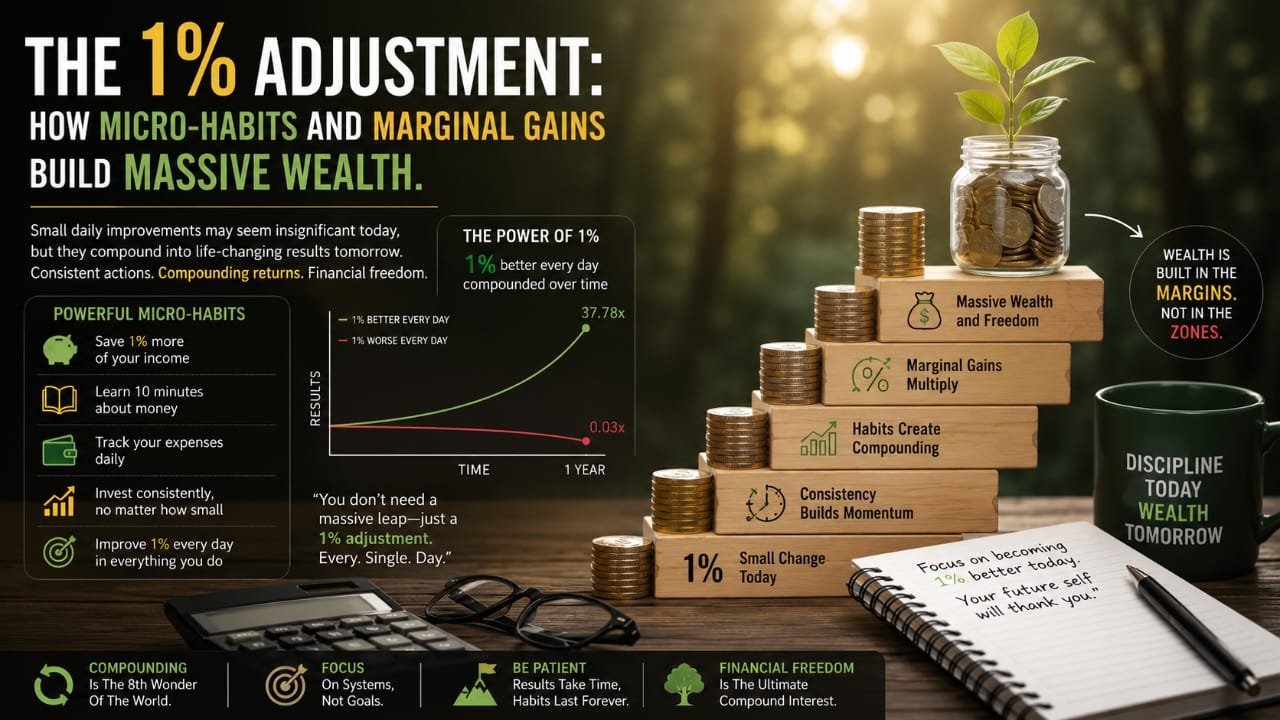
When people want to transform their finances, they usually imagine drastic, painful changes. They plan to cut every luxury, eat only basic food, or double their income overnight. Consequently, these massive shifts feel overwhelming, causing people to freeze up and remain stuck in the exact same financial rut year after year. However, the real secret to sustainable wealth is not a radical lifestyle shock. Instead, it relies on accumulating marginal gains through the 1% adjustment. By making tiny, almost invisible improvements to your habits, you trigger an exponential financial snowball effect. Therefore, instead of trying to revolutionize your life in a single day, focus on executing a simple 1% adjustment to build life-changing freedom over time.
The Mathematical Magic Behind the 1% Shift
A 1% change sounds tiny on paper. If you earn $5,000 monthly, 1% is just $50. In our current economy, $50 covers a single dinner or a tank of gas. It is money you can lose track of without even noticing. However, when you redirect that exact same 1% into a wealth-building asset, compound interest transforms its value completely.
Let us look at a real-world scenario over a standard 30-year career. Imagine earning a steady salary while capturing a conservative 7% annual return:
| Scenario | Monthly Savings | Portfolio Value After 30 Years | The 1% Difference |
| Base Case (10% Savings) | $500 / month | $566,764 | Baseline |
| The 1% Adjustment (11% Savings) | $550 / month | $623,441 | $56,677 |
By adjusting your savings rate by a single percent, you add over $56,000 to your net worth. Furthermore, what happens if you repeat this process? If you raise your savings rate by an extra 1% each year as your salary grows, you avoid lifestyle creep entirely. Consequently, after ten years, you will save 20% of your income effortlessly. This simple habit can easily shave four to seven years off your working career.
The Psychology of the Micro-Habit
Why does the 1% adjustment work so effectively where traditional budgeting fails? The answer lies in human psychology. As humans, we suffer from a phenomenon known as hedonic adaptation. This is our natural tendency to quickly adjust to our surroundings and income levels. When we get a raise, we automatically spend more. When we try to slash our budget by 30%, our brains view it as a severe threat and a painful sacrifice, causing us to abandon the plan.
A 1% adjustment completely bypasses this mental defense mechanism. Because a 1% reduction in your daily spending cash is so small, your brain doesn’t register it as a loss. You adapt to the change instantly. You are working with your psychology rather than fighting against it.
4 Practical Ways to Apply the 1% Adjustment Today
Implementing this high-value strategy does not require hours of financial planning or deep economic knowledge. You can execute these four simple tweaks today to optimize your financial trajectory.
1. The 1% Auto-Escalator for Retirement
Most workplace retirement portals (such as a 401k or company pension dashboard) feature a hidden, underutilized toggle switch called Auto-Escalate or the Annual Increase Program.
Log into your retirement account portal today and hunt for this feature. When you turn it on, it automatically bumps your investment contribution rate up by exactly 1% each year, typically timed to coincide with your annual performance review or raise cycle. Because the money is deducted from your paycheck before it ever lands in your main bank account, you never see it, you never miss it, and your nest egg grows on autopilot.
2. The 1% Spending Rule (The 24-Hour Impulse Brake)
To curb impulse spending on non-essential retail items, tech gadgets, or luxury goods, adopt the 1% Spending Rule.
Calculate what 1% of your gross annual income looks like. If you earn $60,000 a year, your 1% threshold is $600. If you make $100,000, it is $1,000.
Whenever you are tempted to buy a non-essential item that costs more than your 1% threshold, you must force a mandatory, non-negotiable 24-hour waiting period before checking out your digital cart. This simple rule builds an intentional friction point into your life. It gives your emotional brain time to cool off, separating true needs from temporary dopamine hits, and completely eliminates buyer’s remorse.
3. The 1% Micro-Savings Optimization
If you find it difficult to save cash upfront, try trimming just 1% off your fixed monthly infrastructure costs. This doesn’t mean skipping your morning coffee. Instead, look at your fixed bills:
- Spend 10 minutes calling your internet or insurance provider to negotiate a lower rate.
- Audit your digital subscriptions and cancel a single streaming platform or software tool you haven’t used in the last 30 days.
- Enable a “round-up” feature on your banking app that automatically routes the spare change from your daily transactions into a separate account.
Take the money saved from these tiny structural wins and set up an automatic recurring transfer to redirect it straight into a High-Yield Savings Account (HYSA).
4. Optimize Your Investment Fees by 1%
The 1% adjustment doesn’t just apply to what you save—it also applies to what you keep. Many traditional mutual funds and managed portfolios charge an expense ratio or management fee of 1% to 1.5% annually.
While a 1% fee sounds small, it can eat up to 20% to 30% of your total investment returns over a lifetime. Take a close look at your portfolio fees. By shifting your capital out of high-cost actively managed funds and into ultra-low-cost index funds or Exchange-Traded Funds (ETFs) that charge 0.05%, you effectively give yourself a 1% annual raise that compounds directly into your pocket.
Small Hinges Swing Big Doors
Building real wealth is a marathon, not a sprint. The people who achieve true financial independence are rarely those who struck it rich on a volatile stock or won the lottery. Instead, they are everyday individuals who mastered the art of consistency and incremental progress.
You do not need to completely upend your lifestyle, move to a cheaper city, or sell your favorite belongings today to achieve financial security tomorrow. You simply need to find one small, manageable area where you can execute a 1% adjustment. Let consistency, discipline, and time do the heavy lifting for you. Within a few short years, you will look back and realize that your smallest changes yielded your greatest returns.